
Introduction
We received a photo of a newspaper article by a well-known correspondent from our teacher. “You could also send him a message!” he said. We decided to give it a try and sent Patrick van IJzendoorn a message. He responded very enthusiastically and was more than willing to cooperate. A few weeks later, we met him in Amsterdam and had an interview, which helped us further with our research.
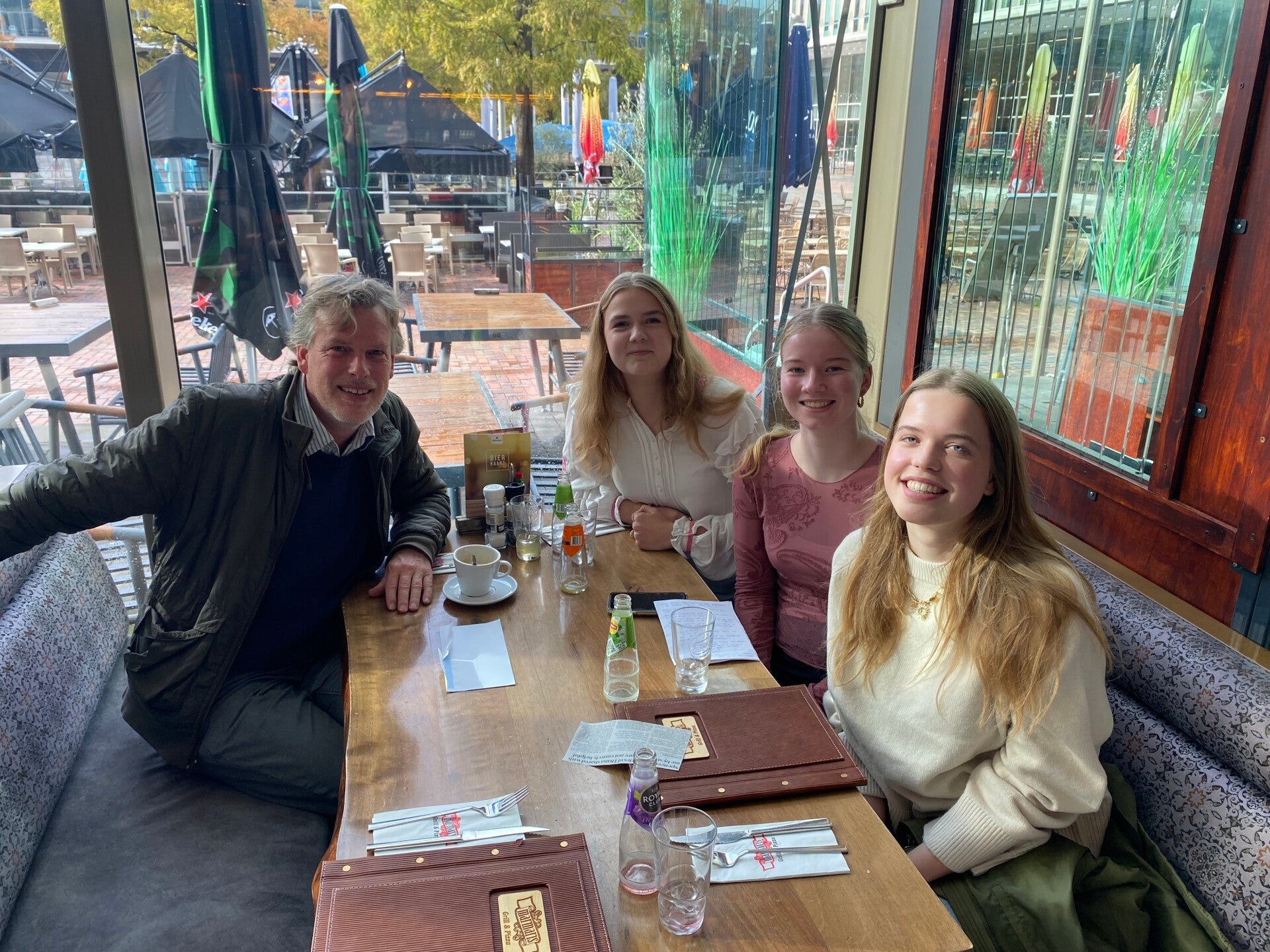
Interview with Patrick van IJzendoorn
Patrick van IJzendoorn is a journalist and writer. He is a correspondent for de Volkskrant in the UK and Ireland. Since 2011, he has been reporting from London on political, economic, and cultural developments.
Is Diana still discussed in the media these days? If so, how?
Well, I happened to think of this topic, when I read the newspaper. About her brother, who is still approached by people. These people tell them where they were the moment the news came that Diana passed away. So, in that case, her name is still being discussed, by people and also the media. In the media, she is often mentioned in connection with her children, William and Harry. They were both young when she passed, and have noticed the consequences. On special occasions, for example the date of her death, there are story’s about her and her life. It’s not like she’s in the newspaper every day, but she is not forgotten. Harry, her youngest son who lives with Megan, is still suing the media, because he believes the media can be blamed for his mother’s death. And sometimes she gets compared to Kate, in certain actions.

Did her death have impact on the paparazzi and the media?
Yes, you could say that. That was a big thing, with the Paris chase. The paparazzi got a bad name back then, especially the photographers. I knew a photographer, Duncan, who also photgraphed her. Later, he regretted his intrusion. But you do see changes in the media. There was an anger of people at the media; that killed her. On the other hand, the reason the media photgraphed her often was because there was so much demand for her. A dual effect.
So, more privacy?
Yes, that’s been the agreement: we give more openness and you more restraint in your pushiness. A few years ago, there was a scandal. A photo was published in the French newspaper, which showed Kate laying in the sun topless. That was a scandal, but these photos were made by the French photographers, who fell outside that agreement. So the English press was more reserved, but the American, German and the French paparazzi were not. But that has been less of a problem compared to the English press of the time. So, they got a bit better in that.
How did her death affect the relationship between the British people and the royal family?
Well, very clearly. She was very unique in her appearance: a young woman, charismatic, very open with the media, she was also a glamour model and had a lot of publicity related to fashion and humanitarian causes, for example AIDS, the famine or the housing shortage. She was a modern princess. That’s very different compared to the distant royal family before. And that’s why she was called ‘People’s Princess’. It indicated that she was close to the people and that she was an innovation for England. That’s why there was an immense mourning that Sunday morning. There was a huge sea of flowers. What’s also interesting is that day and the days after, the royal family and her family were in the north of Scotland, at their summer country house. They saw no reason to come to London, to mourn with the people. That caused a huge revolt among the people. Where was the Queen? She must be mourning with us, right? She must be here. She must offer us comfort. Eventually, she came to London, but that shows the difference between the old royal family, their distance, and the new royal family, their mourning with the death.
Do you think Princess Diana’s legacy is still felt or tangible in England?
Yes, I think that first of all she was a member of the Royal Family who was involved in big humanitarian cases. Cleaning landmines, helping children etc. Actually a mother-figure. Almost a Mother Theresa- figure. The influence is still there. For example, Harry and Megan where involved by preserve nature conservation with Bolsonaro. Likewise Kate is being influenced by Diana: she wants to help people.
It’s been almost 30 years since the death of Diana. How do you think she will be remembered in 50 years?
That’s a great question. The Royal Family is, of course, very old, a thousand years old now. Unlike the Netherlands, which is a few hundred years old. I think she will be remembred over 50 years. I think George will be King. There’s always interest, and still, books about royals from the 16th, 17th, 18th and 19th centuries are still being published in England. So in that case, she won’t be forgotten, because she was important. And because she died young, that whole tragedy makes it different. So this will be remembered for centuries, this will continue to be remembered and discussed.
Which five moments from Diana’s life come to mind first. Moments that truly make Diana Diana.
First of all, I think her wedding with Charles. A big deal. I was still young then. It was a fairytale wedding, which unfortunately went wrong quickly. I don’t think Charles was ever truly in love with her, he was still thinking about Camila. That’s very tragic. The big moment was the famous BBC interview. The one with and the one without Charles. Both legendary. When she said: ‘There were three of us in this marriage, so it was a bit crowded.’ A quote we won’t forget soon.
Why do you think they got married if they never really loved each other?
I think through pressure of the family, especially the father of Charles, but also the mother and grandmother. Look, Charles wanted to marry Camila. But that was a big problem, because she was divorced, so she had a marriage before. That was a big problem for the Royal Family. He was actually forced to marry Diana. She came from a good family. I thought she even is a distant family member of Churchill. She came from an aristocratic family, so a good background, and she was a good candidate, young and handsome. Through pressure of the family this marriage came and that will go wrong some day. Now he is, of course, with Camila, but anyways, to come back to your question about the five moments who make me think of Diana, about the marriage with the pronunciation: ‘It was a bit crowded.’ That was a big thing. Another moment I think of are the awkward interviews with Charles. You sensed a tension: something was wrong here.
The third moment I think of is the famous moment on the road in Africa about the campaign of the landmines. There’s a photo of her wearing a helmet and special moment. That was really a ‘hé’ moment, she is really standing there. Africa was very much in the picture, with the AIDS concert at the time. So it was moment where you see her standing in the desert, a very big moment. So in a nutshell, the interview, the marriage and Africa. A tragic moment, her funeral, especially the moment you see her children walking behind her coffin and the moment her brother gave a speech. He openend the attack on the family. Elton John, her good friend, who sang on the funeral. Those are moment I think about.
Do you think that Princess Diana changed the Royal family, like made it more human?
Yes, for sure. I don’t know if it was her purpose, but she did. That’s the interesting thing about the Royal family, that it has existed for so long. That has to do with adapting to the times. The French Royal family has always remained distant from the public, and in 1789 this family was murdered. This made the English Royal family think: if you don’t change with the times, it will have consequences for the Royal family. There was a King murdereded, Charles the First, they often say that the English behead the king, but the French the monarchy. They owe a lot to Diana in that regard, she warned them: we must not become dusty and irrelevant. That’s interesting though, she talked a lot about her mental health. She suffered from depression. Now you see Harry and William talking about it too, about their mental health issues. This makes them relatable to the public. Diana also had an influence on this.
Do you think the media went too far in sharing Diana’s private life, both during her life and after her death, and what impact did this have?
Yes, I do think so. Especially the photographers, they went too far. How far they were willing to go I can illustrate by a story from a friend I mentioned earlier, Duncan. He heard that Andrew and Sarah Ferguson were going on a holiday to the island Mauritius. He went there. They absolutely did not want paparazzi there. Duncan travelled there and entered the hotel pretending to be a tourist. He found out where Andrew and Sarah were staying. It was completely secluded. Then, he went to a cliff and hid the bushes all day. From there, he could see Andrew and Sarah. At one point, he saw a woman run outside in panic, followed by a man carrying a champagne bucket. These were Sarah and Andrew. The barbecue had caught fire, so Andrew grabbed water and put out the flames. For Duncan, it was a dream: fantastic photos that immediately made the front page. In itself, it was harmless: it wasn’t erotic or anything, it was humorous. But it does show how far the media was willing to go to get photos of the Royal family.
There was a double effect, but the royal family benefited from the publicity as well. Furthermore, Diana had an affair with her butler. There are even rumours that Harry is the butler’s son, but that’s another story. It is understandable that she had an affair given Charles’s emotional coldness. But the British newspapers played a big role here. In the Netherlands, people have a newspaper subscription and you receive it at home. In England, many people do not have subscriptions. So newspapers in shops need an eye-catching front page to attract buyers. There are no guaranteed subscribers. Rivalry also plays a role: everyone wants the best photo. The former owner of The Sun once said that the Royal family was a gold mine for the newspaper, there were endless stories to tell.
What exactly happened in the tunnel is still unclear. They were driving very fast, partly because of the paparazzi, and apparently a journalist had been drinking as well. The media definitely went too far. Whatever exactly happened, the media also tapped phone, for example those of ministers and even Prince Harry. This was done by News of The World. The newspaper was shut down because of it. This clearly shows how far the media went.
Which documentaries do you think provide the best picture?
I think the book written by Andrew Morton. It shows her side of the story.
There is a serie called ‘The Queen’. Does that give a good impression?
I think it gives a controversial image. The funny thing about that serie is that it portrays the image of the past centuries. As is gets closer, more questions are asked about whether it paints a good picture. It’s certainly entertaining and well-made, but I wouldn’t trust it. It’s romanticized and not realistic.