
Introduction
During our research we read a lot of articles. A name that we kept seeing was Lia van Bekhoven. To deepen more into our subject, we thought it would be amazing if we could interview her. We never imagined such a well-known person would respond to our request. We still tried and with succes. A couple weeks later we interviewed her over the phone.
Interview with Lia van Bekhoven
Lia van Bekhoven is a Dutch correspondent who has been reporting in the United Kingdom for more than 40 years. She was in the United Kingdom when Diana died. She was able to tell us a lot about the impact of this intense event.
How was Diana represented in the media in England before her death?
I think that at first the media thought in a very black-and-white way, especially about the scandals. They saw Diana as someone who had to modernize the dusty, old-fashioned British royal family. In the beginning, she was seen as new hope. She was in the public eye for almost 20 years, so it is a long story. The mood started to change when the media focused on her private life, because she was followed all the time. She found it difficult to live her own life like that. People started to see her more and more, because she became very popular. This popularity became a problem for Charles. He found it hard to see her as the woman everyone actually came out into the streets for

I remember a moment in Wales, when they were not married yet, only engaged. They went somewhere, and the street was full of people. Diana got out on the left side, and Charles on the right. On the right side, where Charles got out, you could really hear a sigh of disappointment, because everyone wanted to stand on the other side. Charles found that disappointment very hard to deal with. I think that if you look at William and Kate, for example, William has much less trouble with this. Because of Charles’s personality, he found it hard to give Diana things or to let her shine. When the divorce started, people began to look at her very differently. The country was divided into two camps: Team Diana and Team Charles. Team Charles said that she was a threat to the crown and an opponent of Charles. It really depended on what you listened to, to understand what people thought about her.
How can you best describe the feeling in the United Kingdom when Diana died?
Almost hysterical! Great Britain was still seen as a country with a “stiff upper lip,” where emotions were hidden and people did not openly show their feelings. But after her death, nothing was left of that stiff upper lip. It was very remarkable and very unexpected, and therefore very exciting to see as a journalist. The press was constantly following public opinion, watching how hard her death hit and how the British people reacted. The fact that the British let themselves go emotionally was also a shock to the English people themselves. Years later, when you talk about it with British friends, they say they feel embarrassed because they showed their emotions so openly. About 10 million bouquets of flowers were placed at the palaces. The whole country was crying for a whole week over the death of a woman they did not know and had never met. It was a very strange moment, maybe one of the most fascinating moments since I have lived here.

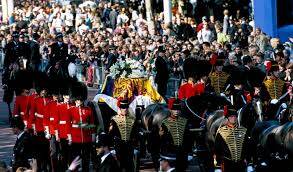
Did her death also change the relationship between her and the British people, and the way people looked at the British royal family?
Well, just before she was buried, it almost felt like the United Kingdom could become a republic. There was so much anger, also towards the Queen. Elizabeth thought it was a good idea to stay in Scotland with her two grandsons, Diana’s sons. They were already on holiday there and were protected from the media. But the British people wanted to see her. They wanted to see that she shared the sadness of the people and demanded that she come to London with her grandchildren. From a protocol point of view, that may have been a good plan, but if you look at the emotional effects on the boys, it was very harmful. Making them walk behind the coffin afterward was also extremely difficult. The anger towards the Queen was real, but it faded fairly quickly.
Is she still sometimes talked about in the media in Great Britain, or has that mostly stopped now?
It was almost 30 years ago. I also noticed how quickly the British people have forgotten her. I still remember on the day of the funeral, everyone was crying and saying they would never forget her. In the first year after her death, I remember walking to Kensington Palace and the fence was still full of cards and flowers with messages like “We will never forget you.” By the next year, there was almost nothing left. Three years later, everything was gone, so the British people forgot her very quickly.
Do you think Diana's legacy is still noticeable, felt or visible in Great Britain?
I think she did change the royal family. She at least gave the royal family and the country the idea that the monarchy was cooler, more modern, and younger because of Diana. That was the illusion, but maybe the royals would have changed anyway even without that illusion. She changed the royal family in the sense that, for example, the Queen also started visiting homeless centers and similar places, which is something Diana did and Elizabeth would not have done otherwise. Elizabeth only got involved with the military, charities connected to the national ballet, the army, and the church. Diana always went much further, and yes, Elizabeth also started doing that too.
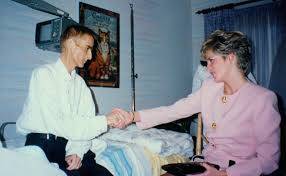
So the Royal Family maybe became more human?
Yes, more human indeed. Furthermore, it is how it works, they have become more aware of press, media and marketing etc. They became very good at that, but more modern and openly? No
Of course a lot has been told about her death in the media, but do you think that is the whole story, or that a lot has been kept secret?
I think we know almost everything about her. Well, not absolutely everything you never really know everything about a person. She had that book written about her herself, so we know what she thought about the people in her life. Some people thought she was neurotic, and that is understandable. I also think people look at her differently now. We see her as a woman who was more complex than she appeared. She carried her past with her: how she was raised, her mother’s divorce, the feeling of being left behind. Then she fell in love with a prince who also had a relationship with someone else, so she was not number one for him. Of course, that leaves scars. She wanted to be loved, and also loved by the people, but not by her family, and certainly not by her in-laws. In that sense, it was a different time. The rules for the media back then are not relevant in a time of TikTok and Instagram.